High-Power Commercial EV Charging Systems
Explore our export-ready high-availability electric car supply equipment (EVSE), thoroughly evaluated under full-load thermal conditions and fully compatible with OCPP 1.6J and 2.0.1 protocols.





Global EVSE Commercial & Industrial Landscape
Macroeconomic tailwinds, regulatory decarbonization mandates, and the mass transition to high-voltage battery platforms are reshaping electric car charging infrastructure requirements across municipal and enterprise grids.
31.4%
Global EVSE CAGR (2024-2032)800V-1000V
Next-Gen Bus Architecture96.5%+
SiC Power Conversion Efficiency500,000+
Annual Production CapacityCorridor Electrification & AFIR Standards
The European Union's Alternative Fuels Infrastructure Regulation (AFIR) and the U.S. National Electric Vehicle Infrastructure (NEVI) program have shifted procurement dynamics. Charging station operators are no longer deploying isolated 50kW chargers; the baseline has elevated to reliable 150kW–400kW DC fast charging stations spaced systematically along strategic transit corridors.
Fleet Electrification & Heavy Transport
Commercial transport fleets—encompassing intra-city logistics vans, municipal transit buses, and drayage trucks—demand specialized charging topologies. Depot charging requires split-type DC architectures capable of dynamic multi-channel load balancing, where a single centralized power matrix delivers from 360kW up to 720kW across 8 to 12 charging dispensers without stranding power.
Grid Constraints & Storage Integration
Public utility transformer bottlenecks frequently delay multi-megawatt charger deployments by up to 24 months. As an adaptive countermeasure, battery-buffered integrated energy storage charging systems (pairing 100kWh–200kWh lithium iron phosphate packs directly with DC fast chargers) allow rapid site commissioning without massive upfront grid reinforcement capital expenditures.
China Factory Efficiency: The Yangtze River Delta Advantage
Suzhou HizonSun Tech Co., Ltd. operates its principal 10,000 m² smart manufacturing plant in Kunshan, Jiangsu Province, directly situated within the world's most concentrated power electronics and precision component manufacturing cluster. This geographical positioning affords unmatched advantages for OEM/ODM partners worldwide:
- End-to-End Vertical Integration: From sheet metal laser cutting, robotic welding, and anti-corrosive powder coating to internal PCB surface mount technology (SMT) and magnetics winding, all manufacturing processes remain strictly in-house.
- Rapid Prototyping & DFM Cycles: Custom mechanical chassis designs, custom dual-connector harness configurations, and bespoke touch-screen display housings transition from CAD drawings to fully functional pilot samples in less than 21 days.
- Rigorous Environmental & Aging Validation: Every DC cabinet undergoes mandatory 72-hour full-load thermal burn-in testing, high-voltage insulation tests, harmonic distortion spectrum analysis, and water-ingress validation prior to seaworthy packaging.
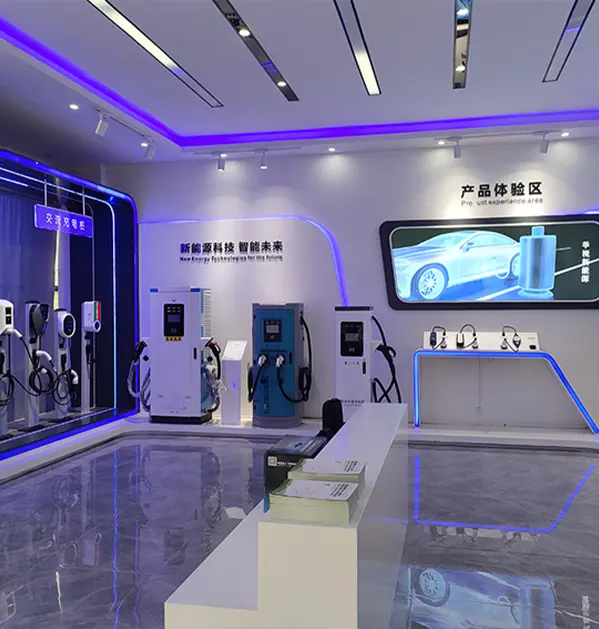
Engineering Anatomy: Modular DC Piles to AC Wallboxes
Reliability in demanding field environments requires multi-tiered electrical protection, aerospace-grade component selection, and modular sub-rack topologies that eliminate single points of operational failure.
Silicon Carbide (SiC) Rectifiers
Employing 20kW, 30kW, and 40kW hot-swappable Silicon Carbide power modules delivering peak conversion efficiencies exceeding 96.5%, operating with an ultra-wide output range of 150VDC to 1000VDC to support both legacy 400V sedans and 800V commercial trucks.
Comprehensive Isolation & Safety
Integrated Type-B Residual Current Devices (RCD), emergency stop physical loopbacks, over/under-voltage protection, lightning surge arrestors (Class II/SPD 20kA), smart electronic door-interlocks, and proactive DC insulation monitoring that cuts high voltage in <10ms.
IP54 / IP55 Outdoor Enclosures
Heavy-duty galvanized steel or aluminum enclosures featuring dual-chamber thermal isolation ducts. Power modules breathe through dust-filtered centrifugal vents while delicate mainboards and billing controllers operate within an isolated hermetic compartment.
Universal Protocol Compatibility
Full support for ISO 15118 (Plug & Charge), DIN 70121, CHAdeMO 2.0, GB/T 27930, and OCPP 1.6 JSON / OCPP 2.0.1. Embedded cellular 4G/5G, Ethernet, and RS-485 interfaces enable seamless integration with any global Central Management System (CSMS).
Localized Application Scenarios & Engineering Fit
Deploying electric car charging infrastructure involves balancing vehicle dwell time, electrical substation allowances, payment processing habits, and harsh outdoor ambient conditions.
Highway Ultra-Fast Hubs
High vehicle turnover dictates 180kW to 400kW integrated dual-gun DC chargers or 720kW split-type matrices equipped with liquid-cooled CCS2/NACS cables. Drivers recharge 20% to 80% SoC in under 15 minutes, supported by automated POS credit card terminals for friction-free ad-hoc payment.
Retail & Commercial Destinations
Shopping malls and mixed-use districts leverage 60kW to 120kW DC fast chargers paired with high-brightness 32-inch IP65 outdoor advertising LCD screens. Commercial property owners monetize both kilowatt-hour dispensing fees and high-visibility digital-out-of-home (DOOH) video advertising.
Municipal Bus & Fleet Depots
Overnight fleet operations prioritize scheduled smart charging. Split-type power cabinets dynamically distribute low-amperage trickle charging across hundreds of parking bays while reserving peak 250A bursts for vehicles requiring rapid turnaround, all synchronized via automated peak-shaving software.
Residential & Workplace Destinations
Where vehicle dwell times exceed 4 to 8 hours, 7kW to 22kW smart AC wallboxes provide the most cost-effective solution. Equipped with Type 2 or GB/T sockets, RFID card reader authentication, and dynamic load balancing (DLB), they safeguard existing building electrical panels against nuisance trips.
Emerging Trends Reshaping EV Charging Infrastructure
The transition toward sustainable mobility is accelerating technological shifts across hardware topologies, grid interactivity, and payment compliance standards:
- Megawatt Charging Systems (MCS): High-capacity commercial vehicles require up to 1.2MW charging rates. Next-generation liquid-cooled split power converters will deliver over 1000A at 1250VDC to electrify class-8 long-haul trucking networks.
- Bidirectional V2G & V2X (ISO 15118-20): Moving beyond unidirectional charging, bi-directional AC and DC chargers allow parked EV battery fleets to serve as distributed energy storage assets, injecting power into municipal grids during peak-tariff windows.
- AI-Driven Predictive Diagnostics: Embedded thermal sensors on charging contact pins and power electronics leverage micro-controller machine learning models to detect contact oxidation and cooling fan degradation before thermal shutdowns occur.
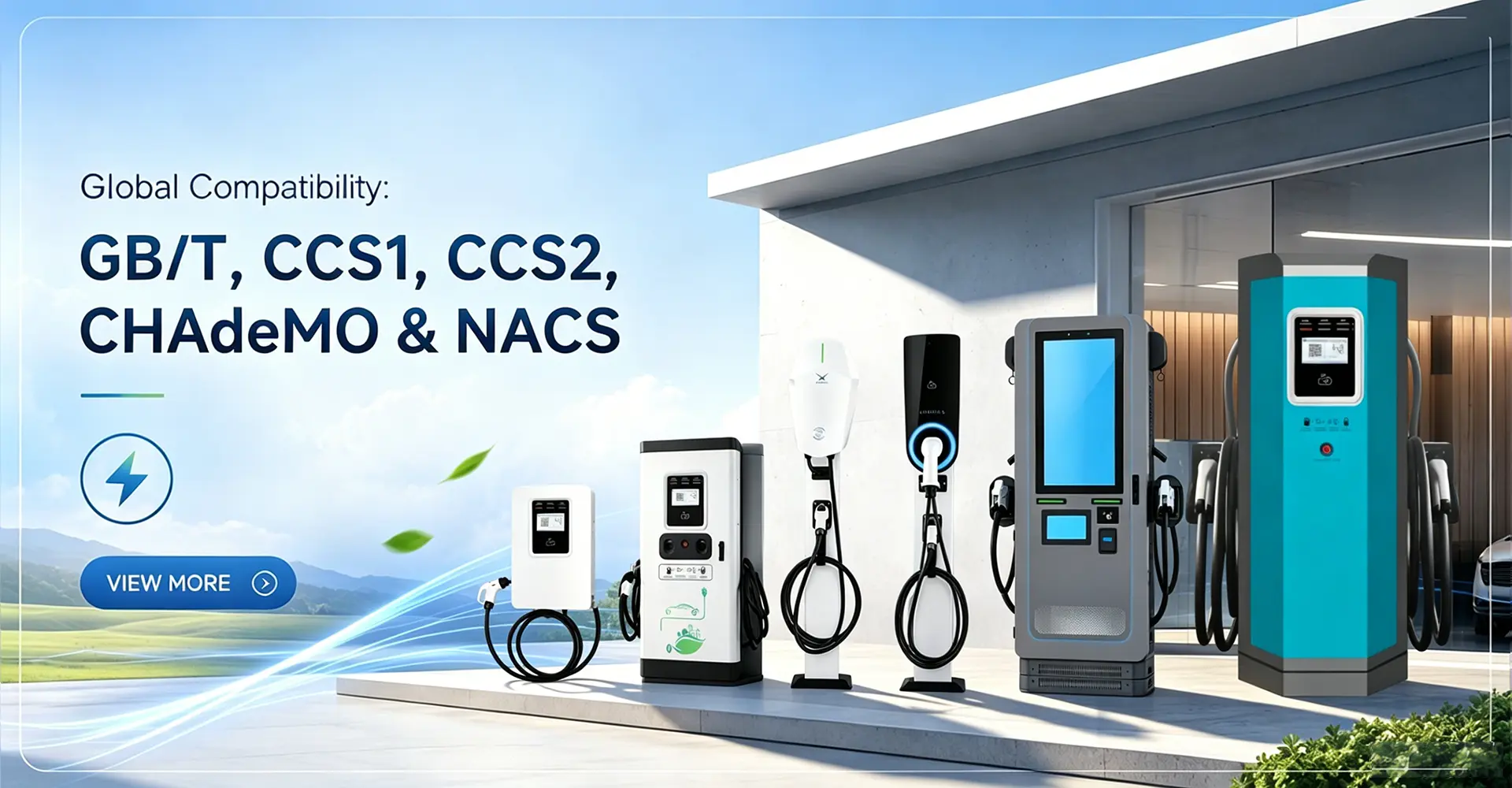
Global B2B Procurement Strategy & Technical RFP Criteria
Procuring commercial EV charging hardware requires strict technical vetting. Evaluating manufacturers against standardized compliance benchmarks ensures long-term operational resilience and low total cost of ownership (TCO).
1. International Certification Compliance
Validate that all chargers hold authentic test laboratory reports for destination markets: CE (LVD/EMC) under EN 61851-1 and EN 61851-23 for the European Union; UL 2202 and UL 2594 for North America; and CQC/GB standards for China. Never rely solely on self-declarations without full TÜV or Intertek certification bodies.
2. Open Communication & Protocol Agility
Avoid proprietary vendor lock-in. EVSE hardware must support fully open OCPP 1.6J or OCPP 2.0.1 profiles over secure WebSockets (TLS). Ensure field units can be remotely re-pointed to alternative CSMS backends via over-the-air (OTA) configuration changes without requiring physical technician visits.
3. Modular MTBF & Field Maintainability
Require minimum Mean Time Between Failures (MTBF) ratings of 50,000+ hours on DC power conversion modules. Verify that internal modules feature hot-swappable sub-rack architecture so local technicians can replace a damaged module within 10 minutes without taking the entire charging station offline.
Frequently Asked Questions: Global Procurement & Engineering
Comprehensive technical guidance written by senior power electronics engineers to address questions on standards, customization, and deployment feasibility.
What charging standards and connector types do your charging piles support?
How does dynamic power allocation work in 360kW-720kW split-type systems?
What level of customization is offered under OEM and ODM procurement agreements?
How do your DC fast chargers perform in extreme temperatures and hostile climates?
When should an operator select an energy storage integrated DC charging pile?
What certifications accompany export shipments, and can you assist with local utility approvals?
Wallbox, Commercial Floor-Mounted & Fast DC Solutions
Explore the remainder of our engineered product catalog, spanning compact DC wallboxes for auto dealerships through heavy-duty octagonal fast charging stations.



Suzhou HizonSun Tech Co., Ltd. — Your Global EVSE OEM Partner
With more than 8 years of dedicated focus on new energy vehicle charging engineering, Suzhou HizonSun Tech Co., Ltd. serves as the trusted manufacturing backbone for charge point operators, automaker concessionaires, commercial real estate developers, and utility procurement divisions across more than 40 countries.
Headquartered at Building 103, Baoyu Plaza, North Changjiang Road, Zhoushi Town, Kunshan City, Jiangsu Province, our state-of-the-art facility integrates comprehensive engineering laboratories, burn-in verification tunnels, and 36 international sales and technical support centers across North America, Europe, South America, and Southeast Asia.
- Over 50 Proprietary Patents: Covering dynamic power conversion matrices, intelligent thermal mitigation, and smart charging cloud software architectures.
- Direct Factory Commercial Pricing: Competitive cost structures achieved through scale and industrial cluster integration without sacrificing quality or compliance.